


For eczema-prone skin, the best soap is a fragrance-free, syndet or pH-balanced cleanser that removes dirt without stripping your skin’s natural lipids. Tallow Skin Co.'s Simply Tallow bar and Grass-Fed Glow Foaming Tallow Cleanser are both built around this idea: unscented, minimal ingredient lists, and a fat composition that mimics the lipids already present in human skin.
The reason this matters comes down to chemistry, not marketing. Traditional bar soap is alkaline, often sitting above pH 9, while healthy skin sits closer to a pH of 4 to 6. A soap that mismatches your skin’s natural acidity can leave it more vulnerable to irritation and moisture loss.
- Fragrance-free. No essential oils, no synthetic perfume, nothing that commonly triggers flare-ups.
- Barrier-supporting. Grass-fed tallow closely resembles the lipid profile in human sebum, so it cleanses without the tight, stripped feeling that follows a harsh soap.
- Consistent with NEA-style criteria. The formulations avoid the ingredients most often flagged as problematic for eczema-prone skin, echoing what clinicians recommend.
Key Takeaways
The best soap for eczema-prone skin is a fragrance-free, syndet or pH-balanced cleanser paired with immediate post-wash moisturizing, since cleanser choice and timing together determine how well your skin barrier holds up day to day.
| Point | Details |
|---|---|
| Choose syndet over alkaline soap | Look for pH-balanced or syndet labeling, since traditional soap’s high pH disrupts the acid mantle. |
| Avoid the big four irritants | Steer clear of fragrance, SLS/sulfates, dyes, and drying alcohols on ingredient labels. |
| Moisturize within three minutes | Apply moisturizer right after patting dry to lock in hydration before water loss accelerates. |
| Patch test every new product | Test on calm skin for 24 to 48 hours before adding a new soap to your full routine. |
| Consider tallow-based formulations | Thetallowskinco’s unscented bars and cleansers use grass-fed tallow to support the lipid barrier during cleansing. |
Table of Contents
- Why the Right Soap Matters for Eczema-Prone Skin
- What Should You Look for in an Eczema-Friendly Soap?
- Tallow Skin Co. Products Suited for Eczema-Prone or Very Dry Skin
- How to Wash Without Triggering a Flare-Up
- What Does the Research and Dermatology Guidance Actually Say?
- Matching Soap Formulations to Eczema Severity
- Why Skin pH Compatibility Matters So Much
- How to Patch Test a New Soap Before Committing
- Common Misconceptions About “Natural” and “Gentle” Soap
- Does Water Hardness Affect Eczema-Prone Skin?
- How Often Should You Wash and Moisturize During the Day?
- Where to Read More on This Topic
- Why the Standard Soap Advice Falls Short
- Find Your Eczema-Friendly Routine With Thetallowskinco
- Frequently Asked Questions
- Sources
Why the Right Soap Matters for Eczema-Prone Skin
Every time you wash, you are doing more than removing dirt. You are also removing some amount of the lipid layer that keeps water inside your skin and irritants outside. For most people, this barrier repairs itself within hours. For someone with eczema, that repair process is already slower and less efficient, so a harsh cleanser does disproportionate damage.
Dermatology research backs this up directly. A clinical review on atopic dermatitis and skin care found that traditional alkaline soaps disrupt the skin’s protective film and increase transepidermal water loss, the technical term for how much moisture escapes through the outer skin layer once the barrier is compromised. That water loss is a major driver of the dryness, cracking, and itching that make eczema so uncomfortable.
The core idea to remember: a cleanser’s real job for eczema-prone skin is not to deep-clean. It is to remove sweat, allergens, and surface debris while leaving as much of the lipid barrier intact as possible.
That distinction changes how you should think about “clean.” A squeaky-clean, tight feeling after washing is often a sign the soap removed too much, not a sign it worked well. Soap-free and syndet cleansers, which use synthetic gentle surfactants instead of traditional saponified fats, tend to score better on this front because they are formulated closer to skin’s own pH.
This is also why moisturizer timing matters so much, which we cover in detail later. A cleanser that respects the barrier gives your moisturizer and any prescribed treatment a much better foundation to work from. Think of the soap as the first domino: get it right, and everything downstream, from lotion absorption to flare-up frequency, tends to go smoother.
What Should You Look for in an Eczema-Friendly Soap?
Reading a soap label with eczema in mind is a specific skill, and most people never learn it because most soap doesn’t require this level of scrutiny. Here’s what actually matters once you’re standing in the aisle or scrolling an ingredient list online.
- Check for “syndet” or “pH-balanced” language. These formulations use gentler, synthetic surfactants instead of the harsh saponified fats in bar soap.
- Look for glycerin, ceramides, or colloidal oatmeal. These ingredients hydrate and support the barrier rather than fighting against it.
- Favor short ingredient lists. Fewer ingredients generally means fewer chances for a hidden irritant.
- Confirm it says “fragrance-free,” not just “unscented.” Unscented products can still contain masking fragrances.
- Skip anything with SLS, sulfates, dyes, or drying alcohols. These are the most common culprits behind post-wash tightness and stinging.
The National Eczema Association’s Seal of Acceptance exists precisely because most people don’t have time to parse ingredient chemistry every time they shop. Products carrying the seal have been screened against a defined list of common irritants, which shortcuts a lot of the guesswork.
Pro Tip: Ignore the word “natural” on its own. It tells you nothing about pH or irritant content. A soap can be entirely plant-derived and still be aggressively alkaline.
Tallow Skin Co. Products Suited for Eczema-Prone or Very Dry Skin
Formulation matters more than marketing language, so here’s how each product in the lineup fits into an eczema-conscious routine and where it works best.
- TALLOW SOAP | SIMPLY TALLOW: An unscented bar built for body and face use, standout feature is its minimal ingredient list centered on grass-fed tallow, which replaces stripped lipids as it cleanses. Best for daily use on both flare-prone and calm skin.
- Grass-Fed Glow Foaming Tallow Cleanser: A pump-format foaming cleanser for anyone who dislikes bar soap residue, standout feature is that it delivers tallow’s barrier-supporting fats in a lighter, rinse-friendly texture. Apply, lather gently, rinse within a minute or two.
- Farm Silk | Unscented Tallow Cloud Cream: Not a cleanser but the recommended follow-up, formulated for immediate post-shower application. Best applied within three minutes of drying off to lock in moisture before water loss accelerates.
- Primal Tallow Lotion with Emu Oil & Raw Honey: Best where skin needs extra humectant pull, raw honey draws moisture in while emu oil helps it stay put. Good for elbows, shins, and other chronically dry patches.
- HEALING HELPER | Regenerative Tallow Moisturizer: Best for stubborn dry patches and nighttime use, standout feature is its richer, more occlusive texture designed to work overnight while skin repairs itself.
- THE GOAT | Goat Milk Face Cream: Best for sensitive facial skin, standout feature is a lighter hydration profile suited to the thinner skin on your face, where heavier body creams can feel too dense.
How to Wash Without Triggering a Flare-Up
The routine around your soap matters almost as much as the soap itself. Get these steps right and you reduce the odds that washing itself becomes the trigger.
- Use warm water, not hot. Hot water accelerates lipid loss and is one of the most common, and most overlooked, causes of post-shower itching.
- Keep showers short. Five to ten minutes is the general target; longer exposure to water, even lukewarm, pulls more moisture from the skin.
- Lather gently, never scrub. Use hands or a very soft cloth. Washcloths and loofahs add mechanical friction your skin doesn’t need.
- Rinse thoroughly. Leftover residue from any cleanser, gentle or not, can irritate compromised skin.
- Pat dry, don’t rub. Then apply moisturizer within three minutes. Use a pea-sized amount for the face and a generous, visible layer for the body.
Pro Tip: Keep your moisturizer within arm’s reach of the shower. Community and advocacy resources consistently point to that three-minute window as the difference between locked-in hydration and moisture that evaporates before it does any good, according to MyEczemaTeam’s guidance on eczema soaps.
If skin is open, weeping, or actively bleeding, skip soap on that area entirely and follow a dermatologist’s guidance on medicated cleansers. Colloidal oatmeal baths can help calm broader flare-ups, but treat that as a supplement to your routine, not a replacement for prescribed treatment during a severe episode.
What Does the Research and Dermatology Guidance Actually Say?
The clinical consensus is more specific than most product marketing suggests. A PMC clinical review states plainly that patients with atopic dermatitis should prioritize soap-free, fragrance-free, pH-neutral products, because standard alkaline soap actively works against the skin’s own repair mechanisms.
Cleansers are enablers, not treatments. Their real function is to remove irritants without stripping the barrier, so that moisturizers and any prescribed medication can actually do their job once applied.
That framing comes from how the National Eczema Association’s Seal program is built. Products earning the seal are screened against a defined exclusion list of common allergens and irritants, which is why the seal functions as a practical shortcut rather than a marketing badge.
- Traditional bar soap’s high alkalinity is repeatedly flagged as a mismatch for atopic skin, a point echoed by the Pierre Fabre Eczema Foundation.
- Syndet bars and cream cleansers are consistently better tolerated across the guidance reviewed.
- No cleanser, however gentle, replaces prescribed topical treatment for moderate to severe eczema. It supports the treatment plan; it doesn’t stand in for it.
Matching Soap Formulations to Eczema Severity
Mild, occasional dryness and a full flare-up call for different approaches, even though both fall under the same “eczema” label. For mild cases, where skin is dry and occasionally itchy but not broken or weeping, a gentle daily bar or foaming cleanser used once or twice a day is usually enough. The goal is prevention: keep the barrier intact before symptoms escalate.
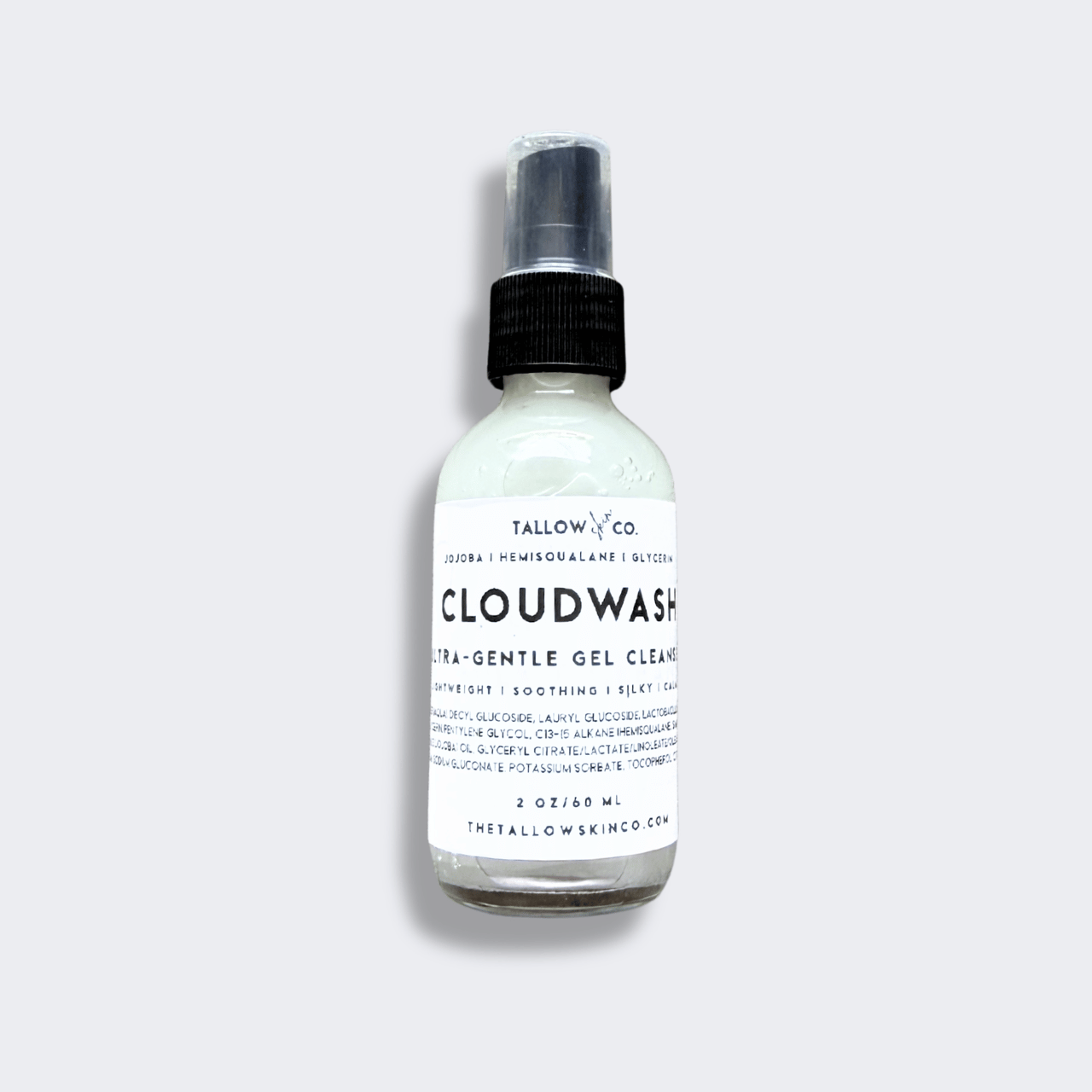
For moderate eczema, where redness and visible patches appear regularly, texture starts to matter more. A creamy or oil-based wash, rather than a foaming one, tends to leave less of that tight, stripped feeling afterward, a pattern noted in editorial testing from Allure’s roundup of body washes for eczema. At this stage, pairing a fragrance-free bar with a richer follow-up moisturizer, rather than relying on the cleanser alone, becomes more important.
Severe eczema, marked by open, cracked, or weeping skin, moves outside what any over-the-counter soap should be expected to manage. This is when a dermatologist’s input matters most; some areas may need to be cleansed with plain water or a medicated cleanser rather than any standard bar or wash, however gentle its formulation. Using a regular soap on broken skin, even a well-formulated one, can sting and delay healing.
The practical takeaway is that severity should guide product choice, not just personal preference. A person managing mild dryness has more room to experiment with textures and formats. Someone in the middle of a moderate flare benefits from simplifying their routine down to the fewest, gentlest products possible. Severe cases need a clinician involved before any soap decision.
Why Skin pH Compatibility Matters So Much
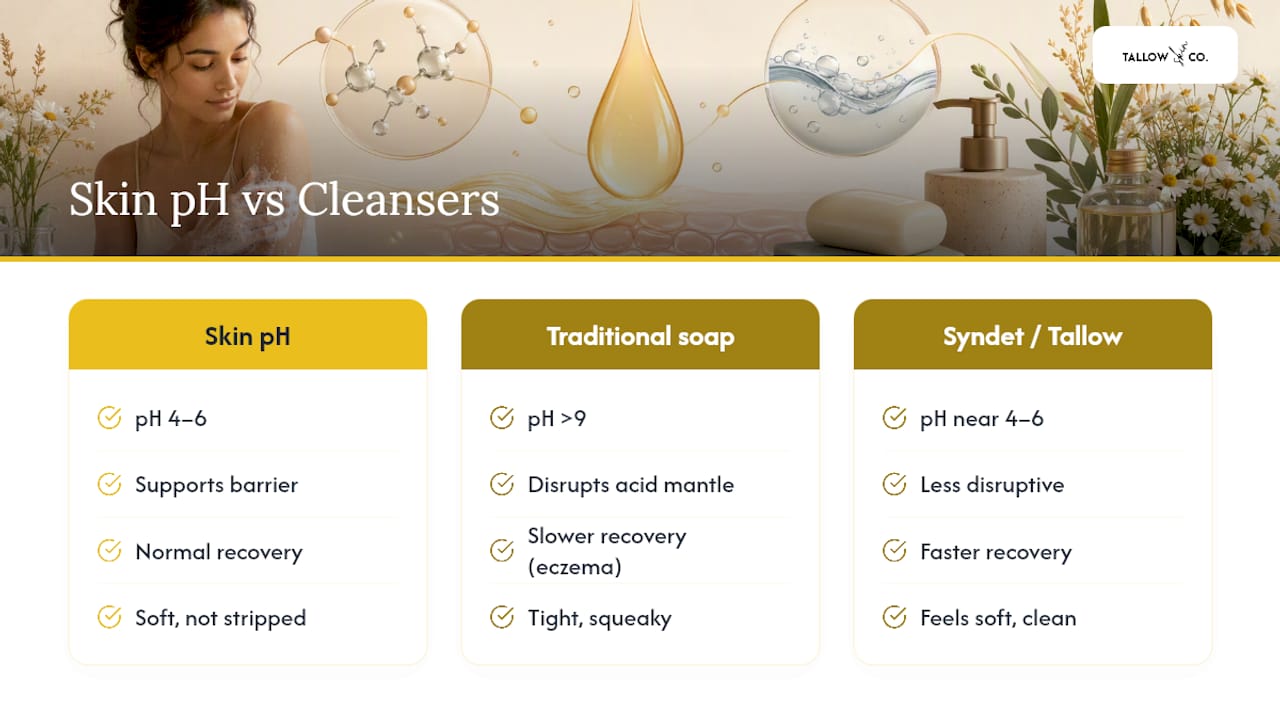
Healthy skin maintains a naturally acidic surface, generally in the range of pH 4 to 6, often called the acid mantle. This slightly acidic environment supports the enzymes responsible for keeping the barrier intact and helps limit the growth of bacteria that can worsen irritation.
Traditional soap sits well above that range, often above pH 9, because saponification, the chemical process that turns fat into soap, naturally produces an alkaline result. Every time an alkaline soap touches skin, it temporarily pushes the surface pH upward, and for eczema-prone skin, that shift takes longer to recover from than it does for typical skin.
This is the actual mechanism behind why “syndet” and “pH-balanced” labels matter so much more than words like “natural” or “organic.” A syndet bar is engineered to sit closer to skin’s resting pH, which means less disruption to the acid mantle with each wash. Tallow-based cleansers tend to perform well here too, since the fat itself doesn’t require the same harsh alkaline processing that vegetable-oil soaps often do.
If you want a quick way to judge this without lab testing, look at how your skin feels fifteen minutes after washing. Tightness, redness, or a squeaky feeling usually signals a pH mismatch. A cleanser that respects your skin’s natural acidity should leave it feeling clean but still soft, not stripped.
How to Patch Test a New Soap Before Committing
Even a well-formulated, fragrance-free product can occasionally trigger a reaction, since eczema-prone skin responds unpredictably to individual ingredients. Testing before full use is a five-minute habit that saves you from a week of irritation.
Apply a small amount of the new soap to a patch of skin that isn’t currently flaring, the inner forearm works well, and leave it on for the amount of time you’d normally use it in the shower before rinsing. Check the area again at the 24 and 48 hour marks, since some reactions are delayed rather than immediate.
Watch specifically for redness that spreads beyond the test area, new itching that starts after the test rather than during it, or small bumps. A little tightness right after rinsing is common with any cleanser and isn’t necessarily a red flag on its own; persistent redness a day later is the signal that actually matters.
If you’re introducing a new product during an active flare elsewhere on your body, test on a separate, currently calm patch of skin rather than near the flare itself. This isolates whether the product is the problem versus normal flare progression. Give any new soap at least a week of consistent use, assuming the patch test clears, before judging whether it’s a long-term fit. One good or bad day doesn’t tell you much; skin needs repeated exposure to reveal a true pattern.
Common Misconceptions About “Natural” and “Gentle” Soap
The biggest misconception in this entire category is that “natural” automatically means safe for eczema-prone skin. It doesn’t. Plenty of plant-derived, essential-oil-laden soaps are marketed as gentle while containing exactly the ingredients dermatology guidance advises against, fragrance chief among them. Lavender, tea tree, and citrus oils are common in “natural” bars and are also common eczema triggers.
A second misconception is that handmade or small-batch automatically equals mild. Craftsmanship affects quality control and ingredient sourcing, not necessarily pH or irritant content. A small-batch soap can still be highly alkaline if it’s made through traditional cold-process saponification without any pH adjustment. What matters is the actual formulation, not the production method behind it.
A third misconception worth flagging: bar soap isn’t inherently worse than liquid cleanser, and vice versa. Format is not the deciding factor. Plenty of liquid body washes contain SLS and synthetic fragrance, and plenty of bar soaps are syndet-based and fragrance-free. Judge the ingredient list, not the shape of the product.
Finally, “hypoallergenic” on a label carries no regulatory definition in the United States. It’s a marketing claim, not a certification. That’s exactly why a defined, criteria-based standard like the NEA Seal of Acceptance carries more practical weight than label language alone.
Does Water Hardness Affect Eczema-Prone Skin?
Hard water, meaning water with a high mineral content, particularly calcium and magnesium, changes how soap behaves on your skin. In hard water, soap doesn’t rinse away as cleanly. It reacts with the minerals to form a residue, sometimes called soap scum, that can linger on skin after you think you’ve rinsed thoroughly.
That residue matters for eczema specifically because leftover soap film can itself act as an irritant, on top of whatever irritation the original cleanser caused. If you live in a hard-water area and notice persistent dryness or itching even after switching to a gentle formula, the water itself, not just the soap, may be part of the equation.
Syndet-based cleansers and tallow-based formulations tend to rinse more predictably in hard water than traditional saponified soap, since they don’t rely on the same fatty-acid reactions that create scum. If hard water is unavoidable in your home, rinsing longer than feels necessary, and confirming no filmy residue remains on the skin, is a reasonable practical adjustment. A shower filter is worth considering if dryness persists despite an otherwise solid routine.
How Often Should You Wash and Moisturize During the Day?
Once a day is generally enough for a full-body wash with soap for most people managing eczema, since over-washing removes more lipid barrier than it protects. Areas prone to sweat, like underarms, feet, and skin folds, can be spot-cleaned more frequently without a full-body soap routine each time.
Moisturizer is a different story entirely, and this is where most people under-apply. Reapplying moisturizer two to three times a day, or any time skin feels tight or dry, is standard guidance for eczema-prone skin, not a sign that your current product isn’t working. The goal is to keep the barrier consistently supported rather than letting it dry out and then trying to repair it after the fact.
A practical rhythm many people find manageable: moisturize immediately after washing, again at midday if skin feels dry, and once more before bed. If you’re using a richer, more occlusive product like a regenerative moisturizer at night, a lighter layer during the day often prevents that midday tightness without feeling greasy under clothing.
Where to Read More on This Topic
- A clinical review on atopic dermatitis and skin care (PMC)
- National Eczema Association — Seal of Acceptance program
- WebMD: What is the best soap for eczema?
Always talk to a dermatologist for guidance specific to your skin and any diagnosed condition.
Why the Standard Soap Advice Falls Short
Most articles on this topic hand readers a checklist and stop there: avoid fragrance, avoid sulfates, look for the seal. That’s necessary information, but it treats soap selection like a one-time decision instead of an ongoing relationship between product, water, climate, and season. The same bar that works fine in a humid summer can leave someone tight and itchy come January, when indoor heating dries out both the air and their skin’s tolerance for anything remotely stripping.
What’s consistently underrated is timing over ingredients. I’d argue the three-minute moisturizing window matters as much as which fragrance-free soap you choose, yet it gets a footnote in most guides while ingredient lists get the spotlight. You can use a genuinely excellent syndet cleanser and still struggle if you’re letting skin air-dry for ten minutes before reaching for lotion.
The other place conventional advice underdelivers is texture. Two products can share an identical “clean” ingredient list and feel completely different on skin, one tight and squeaky, one soft. That’s not marketing, it’s formulation, and it’s why tallow-based cleansers, which mirror skin’s own lipid structure, tend to earn repeat use rather than a single well-intentioned purchase that sits unused in a shower caddy.
Find Your Eczema-Friendly Routine With Thetallowskinco
Thetallowskinco built its cleansers and moisturizers around a simple idea: skin heals better when a product’s fat structure resembles its own, not when it’s stripped clean and rebuilt with synthetic additives. That’s the practical edge here compared to conventional drugstore soap, where you’re often choosing between “effective” and “gentle” instead of getting both from the same bar.
Every formula is handmade in small batches with 100% grass-fed tallow, so you’re not gambling on a long, unfamiliar ingredient list. If you’re ready to build the routine this article walks through, start with the Simply Tallow bar for cleansing and pair it with Farm Silk Cloud Cream for that critical post-wash moisture window. Browse the full lineup and find the combination that fits your skin’s current needs at Thetallowskinco.
Frequently Asked Questions
What is the best soap for eczema-prone skin? The best soap for eczema is a fragrance-free, syndet or pH-balanced cleanser that avoids sulfates, dyes, and drying alcohols. Products carrying the NEA Seal of Acceptance have been clinically screened for common irritants, which narrows the search considerably.
Is bar soap or liquid body wash better for eczema? Neither format is inherently better. What matters is the formulation. A syndet bar can be just as gentle as a well-formulated liquid cleanser, while plenty of liquid washes contain SLS and fragrance that a bar might not.
Are natural soaps automatically safe for eczema? No. “Natural” describes ingredient origin, not pH or irritant content. Many natural soaps contain essential oils, a common eczema trigger, and can be just as alkaline as conventional bar soap.
How often should I wash if I have eczema? Once daily for a full-body wash is generally sufficient, with spot-cleaning for sweat-prone areas as needed. Moisturizer, by contrast, should be reapplied two to three times a day or whenever skin feels dry.
Can hard water make eczema worse? Hard water can leave mineral residue on skin after washing, which may add to irritation on top of whatever the soap itself causes. Rinsing thoroughly and considering a shower filter can help if dryness persists despite a gentle routine.
This article is general information, not a substitute for advice from a qualified doctor. Consult a qualified healthcare professional about your own circumstances before acting on anything here.
Sources
- A clinical review on atopic dermatitis and skin care (PMC)
- National Eczema Association — Seal of Acceptance program
- WebMD: What is the best soap for eczema?